Amputation above both knees: how are above-knee prostheses fitted? A customer story

With amputations above both knees, you stand and walk entirely on prostheses, so the knee component and the way the prosthesis is held to the body are chosen together. This customer chose a single-axis knee that controls bending speed hydraulically and a seal-in (suction) liner, and in an early walking test, holding parallel bars and crutches, felt the knees bend steadily.
Which combination was chosen?
A customer with amputations above both knees asked us to make two above-knee prostheses. In an above-knee prosthesis the knee joint is replaced by a component too, so besides the socket, two further choices have to be made together.
| Component | Our customer’s choice | What it does |
|---|---|---|
| Knee | Hydraulic single-axis knee (for example, the Mauch Knee) | Adjusts the resistance to bending and straightening hydraulically, to suit walking speed |
| Liner | Seal-in suction liner with a ring (for example, a Seal-In liner) | A ring on the outside of the liner seals against the inside of the socket, stopping air moving in and out and holding the prosthesis on |
Liner types are compared in a separate article, so here we focus on the knee.
What is a hydraulic single-axis knee?
“Single-axis” means the knee bends around one pivot; “hydraulic” means oil flowing inside the knee creates resistance that controls how fast it bends and straightens. The knee our customer chose was designed for active users. According to the manufacturer, it adapts to a range of walking speeds and supports stepping foot-over-foot when going down stairs or slopes. It can be used for knee-disarticulation prostheses (amputation through the knee joint) as well as above-knee ones.
When would you lock the knee or let it swing?
The knee has a mode switch: using a lever at the back, the wearer can lock the knee or let it swing without resistance. Situations where this is used include:
- Going down steep slopes
- Climbing ladders
- Standing for long periods
- Cycling
The body is aluminium, so it is light yet sturdy, and its smooth surface makes it easy to finish with a cover in a design you like.
How did the early walking test go?
With new prostheses on both legs, a lot still felt unfamiliar. Even so, taking steps with the support of parallel bars and crutches, our customer could feel the knees bending steadily.
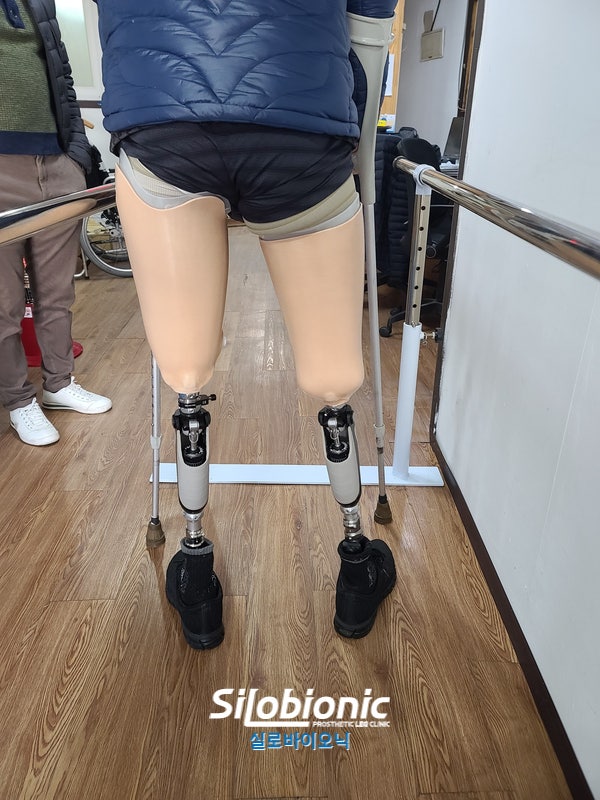
With above-knee prostheses on both sides, there is no sound leg to lean on as there is after a single amputation, so matching the length and alignment of the two prostheses to each other matters a great deal. We keep checking and adjusting while walking becomes familiar. Exercise intensity and the pace of rehabilitation are agreed with your doctor and rehabilitation team.
Are there other kinds of knee?
For above-knee amputation, a microprocessor-controlled (electronic) knee is another option. Sensors inside the knee read your gait and adjust the bending resistance automatically. Whether a hydraulic or an electronic knee suits you depends on the factors below.
Which knee is the right one?
There is no single answer. The right combination depends on the shape and length of the limb, body weight, where you live and what you do, and whether one or both legs are affected. In consultation we go through these one by one and choose the knee, foot, liner and socket together. Cost depends on the components and socket design. Korean residents can check national health insurance or workers’ compensation support with the relevant agencies; overseas customers receive guidance during consultation.
Frequently asked questions
Can I walk with prostheses if both legs are amputated above the knee?
This customer began walking with parallel bars and crutches. What is possible, and how fast, depends on the limbs, strength and overall health, so plan it with your doctor and rehabilitation team.
How does a hydraulic knee differ from a microprocessor knee?
A hydraulic knee uses oil resistance to control bending speed; a microprocessor knee uses sensors to read your gait and adjust resistance automatically. The right one depends on your life and limb.
How does a seal-in liner hold the prosthesis on?
A ring on the outside of the liner seals against the inside of the socket, stopping air moving in and out and holding the prosthesis in place.
When is the knee lock used?
In situations where a fixed or freely swinging knee works better, such as steep descents, climbing ladders, standing for long periods or cycling, the wearer changes mode with a switch.