Below-knee prosthesis hurting after years of use? Repair may help before a remake — a customer story

A painful below-knee prosthesis does not always need to be replaced straight away. Residual limbs change shape and size over time and parts wear, so a check-up and repair can sometimes restore the fit. Our customer arrived with a walking stick and, after the repair, was able to get around without it. Results vary from person to person.
What brought our customer to us?
Our customer had worn the same below-knee prosthesis for a long time, and the discomfort had grown until it became painful. With nowhere to have it checked, our customer simply put up with it and relied on a walking stick because walking felt unsteady. Having lost much of their trust in prostheses, our customer told us they had not expected much when they contacted Silobionic.
Why isn't a prosthesis a one-time job?
Below-knee and above-knee prostheses work through several parts acting together — socket, liner, connectors and foot. And the residual limb inside does not stay the same either. Common changes include:
| Change | What can happen to the prosthesis |
|---|---|
| The residual limb loses volume | The socket becomes loose, so the prosthesis moves or rubs the skin |
| Muscle builds up or swelling appears | The socket gets tight and presses on certain areas |
| Liners, socks and pads wear out | Grip and cushioning are reduced |
| Connectors loosen or alignment shifts | Walking leans to one side |
If the limb changes but the prosthesis does not, it is a bit like walking in shoes that no longer fit. It is no surprise that discomfort and pain follow.
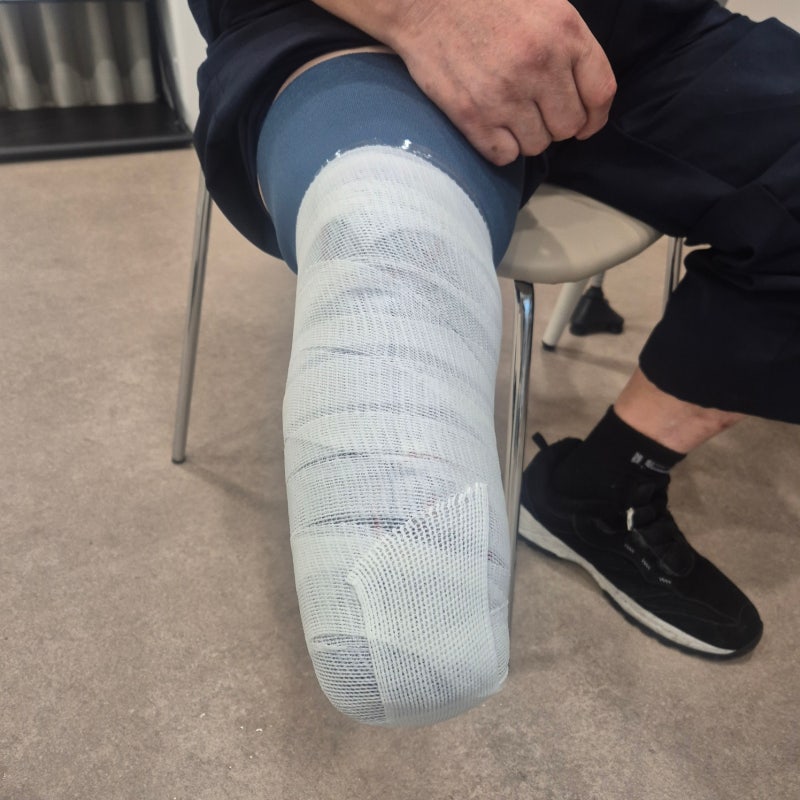
What did we do this time?
We began by looking at the residual limb and the prosthesis together to find where the discomfort came from. We then carried out a repair to adapt the prosthesis to the changed limb. Rather than starting again with a new prosthesis, the aim was to put the existing one back into good working order.
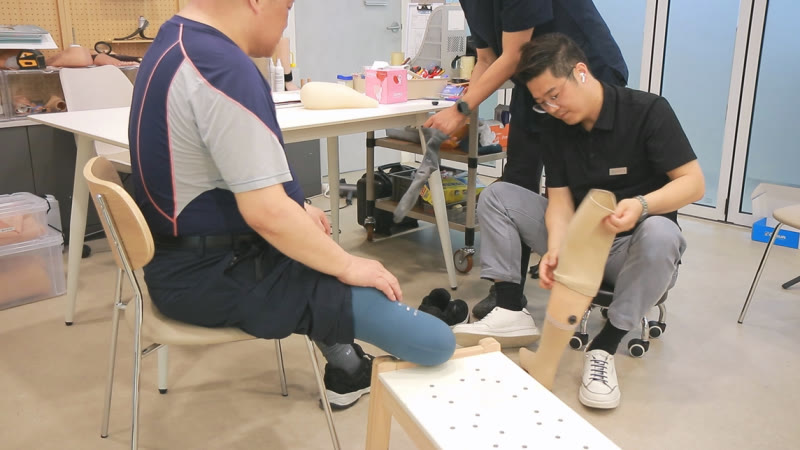
What changed after the repair?
Trying the repaired prosthesis on, our customer was delighted and asked how it could be this comfortable without a new one. The walking stick our customer had arrived with was no longer needed to get around. How much a repair can fix depends on the prosthesis and how much the limb has changed, and results vary from person to person.
How do you decide between repair and a new prosthesis?
There is no fixed checklist — we decide after seeing the prosthesis and the residual limb in person. As a general guide, it can be thought of like this.
| What we look at | A repair may work when… | A new one may be better when… |
|---|---|---|
| Changes in the limb | The change is modest and can be handled by adjustment or padding | Shape and size have changed so much that a new cast is needed |
| Condition of parts | Replacing consumables or adjusting connectors will do | Major components are badly damaged |
| Changes in daily life | Your activity level has stayed much the same | Activity has risen or fallen enough to need different components |
Signs it is time for a check-up
- The prosthesis feels looser than before — or tighter
- The same spot turns red or sore after walking
- You keep reaching for a stick or handrail because walking feels unsteady
- The prosthesis makes noises or the connections feel loose
Depending on what the check-up shows, a repair may be enough, or a new socket or prosthesis may be the better option. At Silobionic we provide after-sales care while you use your prosthesis, and if a repair is not possible we explain why and talk you through a remake. If pain or wounds persist, please see your doctor as well. Check-ups during the adjustment period right after fitting are covered in a separate journal article.
Frequently asked questions
Can you check a prosthesis made elsewhere?
Yes — as with this customer, a prosthesis made elsewhere can be checked. What can be repaired depends on the parts and condition, so we advise after seeing it in person.
How often should a prosthesis be checked?
Your body's signals matter more than a fixed schedule. If you notice looseness, pain or a change in your walking, have it checked without delay.
What if a repair is not possible?
We will talk you through having a new socket or prosthesis made, explaining which part cannot be repaired and why.
Will I get used to a painful prosthesis if I put up with it?
Putting up with it is unlikely to make it better on its own. It may be a fit problem, so have it checked, and if a wound has appeared, please see your doctor.