Amputated just above the ankle with a long residual limb — how is a below-knee socket made?
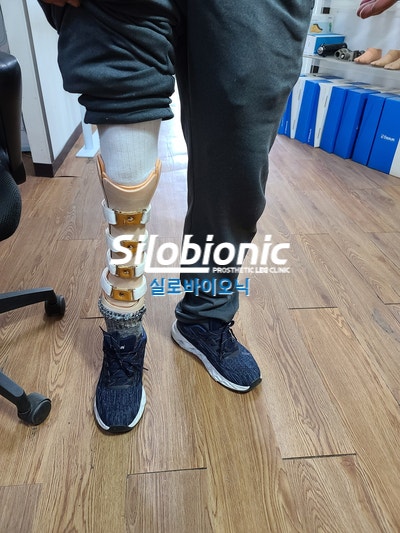
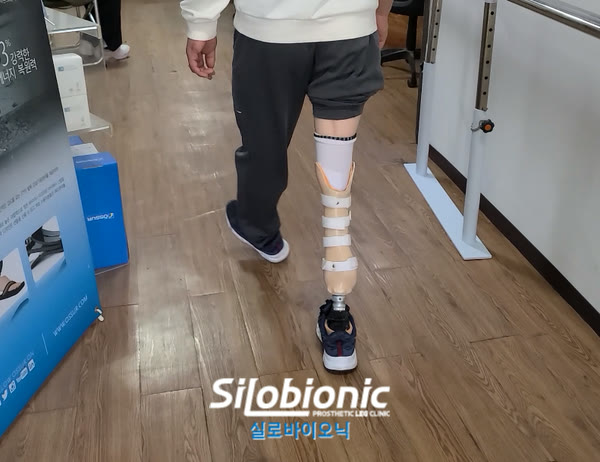
After amputation just above the ankle, the limb is long and wide at the end, so it is hard to get it through the opening of a socket. For this customer we made an open-front socket that is put on from the front and closed with straps, built as a double socket with an added foam lining, and paired it with a low-profile carbon-fibre foot to fit the short space below the limb.
Why is an amputation just above the ankle tricky?
Among below-knee prostheses (for amputation below the knee), an amputation just above the ankle is one of the more difficult cases, for two reasons.
- The limb is long and wide at the end — when the end of the limb is larger than the part above it, the opening of the socket, where the limb enters, is hard to design.
- There is little room for the foot — the longer the limb, the shorter the distance between its end and the floor, so the foot component that fits in between must be low in height.
What kind of socket did we make?
An open-front socket, closed with straps
Instead of a tube-shaped socket that the limb is pushed down into, we made an open-front below-knee prosthesis. The front of the socket opens, the limb goes in, and several straps and buckles tighten it in place. The wide end of the limb does not have to be squeezed through a narrow opening.

A double socket: a foam lining inside a hard outer shell
We used a double socket (for example, a Pelite socket), which adds a soft foam layer inside the plastic socket. The aim is to give a cushioned feel not just underfoot when walking but at the end of the limb as well.
| Feature | Tube-shaped socket | Our customer’s open-front double socket |
|---|---|---|
| Putting it on | The limb is pushed in from the top | Opened at the front, then closed with straps and buckles |
| Consideration | The end of the limb must pass through the opening | A wide-ended limb goes in without passing through the opening |
| Inside | Varies by socket | An added foam lining for cushioning at the limb |
Which foot did we choose?
We chose a carbon-fibre foot with a low build height designed for people with long residual limbs (for example, the Pro-Flex LP). The manufacturer describes these features:
- A grip sole designed for standing barefoot on wet or slippery floors
- A split between the big toe and second toe, so sandals and flip-flops can be worn
- A water-resistant design for wet environments — follow the product guidance for specific uses such as swimming
- Steady toe length and a natural arch for a light, smooth roll-over
If a long residual limb makes choosing difficult
The right socket design and foot depend on the level of amputation, the shape of the limb’s end and the condition of the skin. Even if you have been told a standard socket will be difficult, another approach may be possible, so we recommend deciding together in a consultation where we can see the limb. Comfort and results vary from person to person. Cost depends on the socket design and components. Korean residents can check national health insurance or workers’ compensation support with the relevant agencies; overseas customers receive guidance during consultation.
Frequently asked questions
Can I use a below-knee prosthesis if I was amputated just above the ankle?
This customer was fitted with an open-front double socket and a low-profile foot. The right approach depends on the limb, so we assess it in person.
How do you put on an open-front socket?
The front of the socket opens, the limb goes in, and several straps and buckles tighten it. A wide-ended limb does not have to pass through a narrow opening.
What does the foam lining in a double socket do?
It adds a soft layer inside the hard plastic socket, giving a cushioned feel at the end of the limb when walking.
Why does a long limb need a low-profile foot?
The longer the limb, the shorter the space between its end and the floor, so the foot component that fits there must be lower.