What does a microprocessor knee do in an above-knee prosthesis?
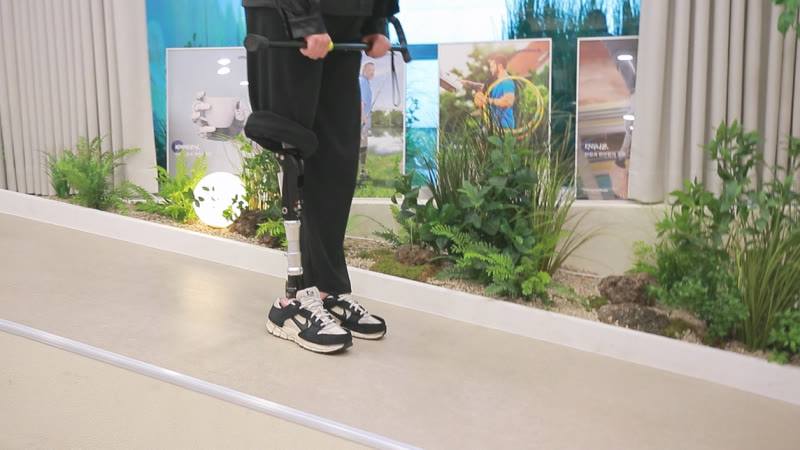
A microprocessor knee is an above-knee prosthetic knee with sensors that read its angle and your walking phase, then adjust hydraulic resistance in real time. It lets the knee bend slowly and under control on stairs and ramps, and holds it firm when you stand. Paired with a foot whose ankle can tilt, knee and ankle adapt to the ground together.
How does a microprocessor knee work?
With an above-knee (transfemoral) amputation, the prosthesis needs a knee joint. A mechanical knee bends and straightens against a resistance that is set in advance. A microprocessor knee uses sensors and a small computer to read the knee’s angle and position moment by moment, opening and closing a hydraulic valve accordingly. It is sometimes called an “AI knee” in Korea, but strictly speaking it is electronic control based on sensor readings.
What functions and modes does it have?
Features vary by model, but most offer something like the following. The Imasen MCK is one example of a knee with separate modes.
- Walking mode — the knee supports your weight as you step onto it and bends smoothly as the leg swings forward.
- Yielding mode — it bends against steady resistance, helping you step down stairs or slopes one foot at a time, or move slowly.
- Cycling mode — resistance is lowered so you can pedal.
- Locked mode — the knee is held straight for long periods of standing or when you need to bear weight.
Many models are also designed with deep bending in mind, such as kneeling or sitting down to change your shoes.
How does it compare with a mechanical knee?
| Mechanical knee | Microprocessor knee | |
|---|---|---|
| Resistance | Works at preset values, adjusted by hand when needed | Changes in real time based on sensor readings |
| Going down stairs and slopes | Varies widely with the model and the user’s skill | Bends slowly and supports you on the way down |
| Upkeep | No charging; relatively simple mechanism | Needs regular charging and electronic check-ups |
| Trade-offs | Usually lighter and less costly | May add weight and cost — weigh it against your activity level |
Why match the ankle to the knee?
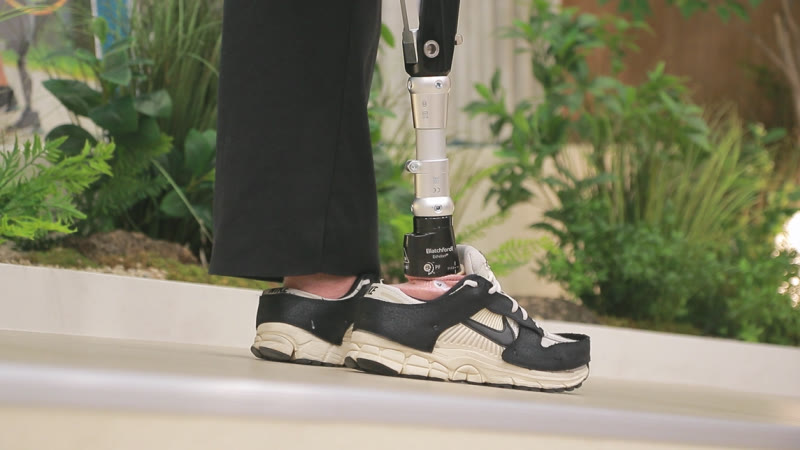
However well the knee supports you, if the foot cannot follow the slope of the ground your body gets pushed forwards or backwards on an incline. So we think of knee and foot as a set rather than choosing them separately. The customer in this example paired a microprocessor knee with a foot whose ankle tilts hydraulically.
During a walking test, our customer told us it had been a very long time since they could stand on a ramp with the legs straight and aligned, looking ahead. With the knee yielding slowly and the ankle taking up the slope, there was less need to twist the body to keep balance. How this feels, and the results, vary from person to person.

Who is it suited to?
- People with an above-knee amputation or knee disarticulation
- People who move between indoors and outdoors and use stairs and ramps often
- People whose walking speed varies a lot, or who want to cycle
- People who can keep up with charging and regular check-ups
If you are mostly indoors, or a lighter leg is your priority, a mechanical knee can be a very good choice. A knee should be chosen by how you spend your day, not by a specification sheet.
What affects the cost?
The cost of an above-knee prosthesis depends largely on the type of knee (mechanical or microprocessor), the foot it is paired with, the socket and suspension, and your activity level. Korean residents may be eligible for national health insurance, workers’ compensation or medical aid support; overseas customers receive a personalised quotation after consultation. At Silobionic we start by working out which functions you need, then recommend a combination to match.
Frequently asked questions
Is a microprocessor knee artificial intelligence?
Not in the sense of a system that learns by itself. Sensors and a microprocessor read the knee’s position and adjust the hydraulic resistance — it is electronic control.
What happens if the battery runs out?
A microprocessor knee needs regular charging. How the knee behaves with a flat battery differs between models, so it is worth checking before you choose.
Is this knee used for below-knee amputation?
Knee components are for above-knee amputation or knee disarticulation. With a below-knee amputation you keep your own knee, so the choice centres on the foot, such as a hydraulic ankle.
Can I ride a bicycle with a prosthetic leg?
Some knees have a cycling mode. It takes practice to get used to, and what each person can do varies.