Can a short thumb (brachydactyly) be improved without surgery?
Brachydactyly (fingers that are short from birth) can be addressed in more than one way — bone-lengthening surgery is not the only route. If surgery feels like too much, or is not what you want, a custom silicone finger prosthesis made to fit over the short finger can restore its length and shape. It takes three standard visits and about 4–6 weeks from consultation to delivery. Please discuss any decision about surgery with your doctor.
What is brachydactyly?
Brachydactyly means the bones of a finger or toe formed shorter than usual before birth. It is often most noticeable in the thumb or little finger. When it affects the thumb, the proportions of the whole hand can look different, and holding a pen or gripping objects may feel awkward.
For some of our customers, how it looks matters more than how it works. They find themselves hiding their hands or feet without thinking — when wearing sandals, or reaching out to shake hands.

Is every short thumb brachydactyly?
No. Brachydactyly is present from birth. If a finger became shorter later, for example after an accident, it needs to be looked at as a partial amputation instead. The right approach can differ depending on the cause, so we suggest having your hand assessed by a doctor first.
How does surgery compare with a silicone finger prosthesis?
| Bone-lengthening surgery | Custom silicone finger prosthesis | |
|---|---|---|
| Approach | The bone is cut and gradually lengthened | A silicone prosthesis made to fit the short finger is worn over it |
| Recovery | Recovery and aftercare time after surgery | No surgery, so no surgical recovery |
| Result | The actual bone length changes | Length and shape are restored while you wear it |
| Deciding | Diagnosis and advice from your doctor | Start with a photo of your hand |
Neither is simply right or wrong; they serve different purposes. Please decide on surgery and its timing with your doctor. If surgery feels like too much, or you would like to improve the appearance while you wait, a silicone finger prosthesis is worth considering alongside it.
How is a silicone finger prosthesis for brachydactyly made?
We do not simply copy the thumb on your other hand. We take moulds of the short thumb together with the fingers beside it, and fine-tune the length and thickness within the proportions of your whole hand. Even with the same condition, hand shape and skin tone differ from person to person, so we work from your hand rather than a template.
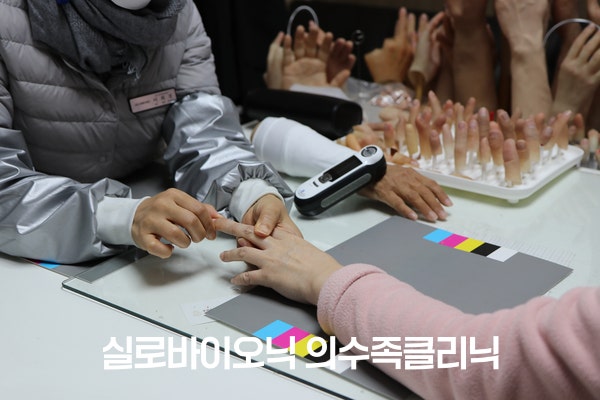
- Skin tone — measured digitally with an E-SKIN scanner (SPECTROMATCH, UK), and custom pigments are mixed from that reading.
- Nails and creases — the nail is made with our patented nail-making method, and skin creases and fine veins are recreated.
- Material — medical-grade solid silicone that can be sterilised in hot water.
- Moulds kept — we keep your mould after delivery, so a remake does not start from scratch.
How many visits, and how long does it take?
- Visit 1 — Casting: we take moulds of the short thumb and the fingers around it to check the overall proportions, and make the basic shape from them.
- Visit 2 — Check-socket fitting: you try a check socket (a temporary trial socket) so we can confirm comfort, length, thickness and skin tone, and your feedback goes into the final prosthesis.
- Visit 3 — Delivery: you wear the finished prosthesis and we make a final check of its shape, fit and skin detail.


Fabricating a finger prosthesis takes 7–10 days, and the whole process from consultation to delivery takes about 4–6 weeks. Express production takes 1–2 weeks. We aim for a result that is difficult to tell apart from a real finger, but results vary from person to person.
Frequently asked questions
Does brachydactyly have to be treated with surgery?
Bone-lengthening surgery is not the only option. Please decide on surgery and its timing with your doctor; if appearance is your main concern, a custom silicone finger prosthesis is worth considering too.
Will a silicone finger prosthesis be obvious?
We mould the short finger together with its neighbours to match proportions, and match skin tone with digital E-SKIN measurement. We aim for a result that is hard to tell apart from a real finger, though results vary.
How many visits will I need?
The standard process is three visits — casting, a check-socket fitting and delivery — taking about 4–6 weeks from consultation to delivery.
Can you help with a short little finger or toe?
Yes. As well as thumbs, other fingers and toes can be discussed for a custom silicone prosthesis. Send us a photo and we will explain what is possible.
Can it be remade later?
Yes. We keep your mould and production records after delivery, so a remake does not start from zero.
Silicone prosthesis for brachydactyly →
Silicone finger prosthesis →