Can a silicone finger prosthesis even out a short little finger (brachydactyly)?
Yes. A finger that is shorter from birth (brachydactyly) can be brought into proportion with a custom silicone finger prosthesis worn over it. For our customer, who dances as a hobby, we shaped the little finger to match the long, slender proportions of the other fingers and fine-tuned the length and fit at the check-socket stage. Whether surgery is an option is a question for your doctor; a prosthesis is one way to restore balance in appearance without surgery.
What concerns does brachydactyly bring?
Brachydactyly is a congenital trait in which one or more fingers are shorter than usual. Even when it causes little difficulty in daily use, the difference in length can stand out when you open or move your hand, and many people find themselves conscious of it.
Our customer was learning to dance as a hobby. In movements where the line has to carry right to the fingertips, the short little finger kept the hand from taking the shape they wanted — that was the main concern.
How does a silicone finger prosthesis even out the length?
- Casting — we take moulds of the short finger and the fingers around it, and decide on a natural length within the proportions of the whole hand.
- Skin tone — an E-SKIN scanner (SPECTROMATCH, UK) measures your skin tone digitally, and we mix pigments from that reading.
- Details — nail shape, knuckle creases and visible veins are matched to the neighbouring fingers. The nail is made with our patented nail-making method.
- Fit — the prosthesis is held on by suction against the finger, so it stays in place through everyday movement.
Our customer has long, slender fingers, so we shaped the little finger slightly longer and finer to suit those proportions.

What changed, before and after?
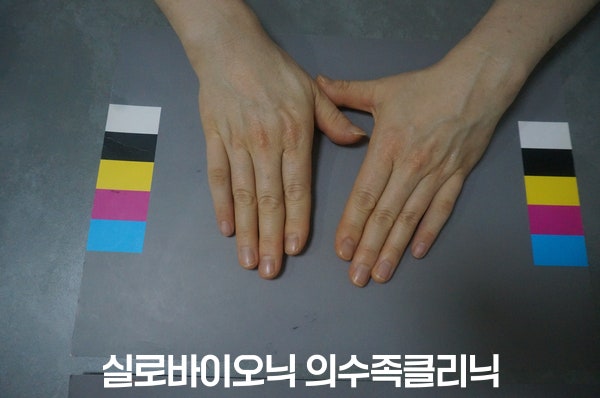
We asked our customer to hold the same dance pose once before and once after putting on the prosthesis. Both photos were taken in the same place and light. The after photo at the top of this page was taken with a standard colour chart and no retouching.


With the fingers spread, the line from the little finger to the others now looks more even. We aim for a finger that is difficult to tell apart from a real one, but results vary from person to person.
What is checked at the check-socket stage?
At the check-socket stage (a temporary trial fitting before the final prosthesis is made), we looked together at whether the length was too long or too short and whether anything lifted away from the skin, and adjusted it based on our customer's feedback. The more your fingertips matter to what you do, the more worthwhile it is to get the length right at this stage.
What if function matters more than looks?
If your work puts frequent pressure on your fingertips — typing, for example — a work prosthesis that drops some cosmetic detail and focuses on supporting the finger may be worth discussing.
| Cosmetic finger prosthesis | Work finger prosthesis | |
|---|---|---|
| Purpose | Appearance and balanced finger length | Supporting finger strength |
| Detail | Skin tone, nails, creases and veins | Cosmetic detail reduced |
| Suits you when | Your hands are on show — performing, photos, meeting people | You use your fingertips repeatedly, such as typing |
We decide together once we have heard about your work and the look you want. The standard process is three visits; from consultation to delivery takes about 4–6 weeks, or 1–2 weeks with express production.
Frequently asked questions
Can you make a prosthesis for a finger affected by brachydactyly?
Yes. Even when a finger is shorter from birth, we can take a mould and make a silicone prosthesis that fits over it. The length is set by looking at the neighbouring fingers and the proportions of your whole hand.
Can I choose a prosthesis instead of surgery?
Whether surgery is right for you is a question for your doctor. A silicone finger prosthesis is one option for balancing finger length in appearance without surgery.
Will it stay on while I dance?
It is held on by suction and designed to stay in place through everyday movement, and the fit is checked at the check-socket stage. How it performs depends on the intensity of the activity, so tell us about the movements you do most.
How is a work prosthesis different?
A work prosthesis drops some cosmetic detail and focuses on supporting the finger. If your work involves a lot of typing or fingertip use, we can discuss it together.
Silicone prosthesis for brachydactyly →
Silicone finger prosthesis →